
Knowledge Article
EPDs explained – 10 key questions about environmental product declarations
Environmental product declarations, often shortened to EPDs, are becoming an increasingly important part of product data sets across the construction industry. In fact, using products which carry EPDs can be hugely beneficial on all kinds of projects, from facilitating more strategic specifications to ensure the highest levels of sustainability to contributing towards the achievement of highly-sought after building standards such as LEED and BREEAM.
1. What is an EPD Certificate?
An Environmental Product Declaration (EPD) is a third-party verified and registered certification that provides transparent information about a product’s environmental impact throughout its lifecycle. They are prepared according to international standards, such as ISO 14025, ISO 21930 and EN 15804 and typically consider aspects such as resource consumption, air emissions, waste management, and embodied carbon from its product and transportation.
EPD’s function is often compared to nutritional labels on food products — to provide a clear and interpretable idea of what’s gone into a product and how it will contribute to the overall ‘health’ of a project. This allows specifiers to make informed decisions about which products to use or manufacturers to collaborate with to ensure the best environmental profile for their project.
2. Why are EPDs so important for construction products?
EPDs can be created for all kinds of products and services. However, they are especially useful within the construction industry as a way of credibly communicating a product’s environmental impact.
Construction and building’s significant contribution to greenhouse gas emissions has been widely recognised for decades, . Much work has been done to tackle this, with efforts having been primarily focused on reducing ‘operational’ carbon emissions, such as those associated with heating, cooling and lighting buildings. So much that, according to the UN Environment Programme, “projections suggest that these operational emissions will decrease from 75% to 50% of the sector's total emissions in the coming decades.”
However, this progress now puts ‘embodied’ carbon emissions generated from the creation and distribution of construction materials under the spotlight. .
EPDs offer the market a clear and structured pathway for construction product manufacturers to identify areas in which they can address their products’ environmental impact across their entire lifecycle, from raw material sourcing to disposal. This could include selecting more sustainable raw materials, optimising supply chains, and improving waste management practices.
They also empower the wider market, providing robust, verified and transparent data that allows specifiers to make informed decisions about their selections and minimises the potential for greenwashing.
3. How does an EPD differ from a Lifecycle Assessment (LCA)?
LCAs and EPDs go hand in hand. An LCA breaks down inputs and outputs at each stage of a product’s lifecycle and estimates the potential environmental impacts generated at each stage. This includes assessing:
- Carbon footprint
- Water use
- Acidification
- Toxicity
LCAs and EPDs go hand in hand. An LCA breaks down inputs and outputs at each stage of a product’s lifecycle and estimates the potential environmental impacts generated at each stage.
This data is then summarised in a standardised format within an EPD in accordance with a specific standard and verified by an independent body. This makes it easily interpretable and comparable across different products, helping specifiers to make the correct choice for their project aims.
4. Are there different types of EPDs?
There are four main types of EPD:
i) Single-company, product-specific EPD - This is the most common type of EPD, looking at the life cycle environmental impact of one or very similar products from one single manufacturer. These are applicable even when a product is produced in multiple factories, providing they all use the same processes. These must be third-party verified and are valid for five years.
ii) Project-specific EPD - These are created for specific projects or contracts. They are typically adapted versions of manufacturers’ verified product specific EPD, which take into account any data variances, such as transportation calculations. These are usually requested by stakeholders such as public procurement on projects which are aiming to manage their environmental impact. Whilst they need to comply with standards such as ISO 14025, they are internally verified by qualified project team members, rather than being third-party assessed.
iii) Group EPD - Group EPDs cover multiple similar products covered by the same Product Category Rules (PCR) produced by a single manufacturer at one or more manufacturing sites using the same core processes. One set of results is declared for one representative product, and it allows for up to 10% difference between the included products’ declared environmental performance indicators.
iv) Sector or industry average EPD - A Sector EPD is developed by an industry association and declares the average product of multiple companies in a clearly defined sector and/or geographical area. Products covered in a Sector EPD must follow the same PCR and have the same functional/ declared unit.
5. What are Product Category Rules (PCR)?
PCRs are a set of rules, requirements, and guidelines for doing lifecycle assessment studies and developing EPDs for one or more product categories consistent with international standards ISO 14025 and ISO 14044. A product category is a group of products that can fulfil equivalent functions — for example, 'floor finishes', 'concrete blocks' or 'insulation’.
A PCR defines:
- Definition and description of the category
- Functional unit
- Description of kind of data that is to be included
- Requirements for data quality, including coverage, precision, completeness, representativeness, consistency, reproducibility, sources and uncertainty
- Units for inputs and outputs where energy is measured in megajoules, or kilowatt hours and mass is measured in tonnes, kilograms or grams.
6. What is the process for getting a product-specific EPD?
The process of obtaining an EPD can be broken down into seven key steps.
i) Scoping - It is important to begin by deciding on the scope of the EPD. This includes the number of products or variations and the lifecycle stages to be covered. This must align with the necessary PCR.
ii) Data collection - Based on the scope, data is collected to help form the LCA model. This includes two main types of data:
- ‘Foreground’ or ‘primary’ data is specific to the product, system, or service being modelled, such as manufacturing energy source, necessary water consumption, production waste, and packaging materials used.
- ‘Background’ or ‘secondary’ data is not directly collected, measured, or estimated, but rather sourced from a third-party life-cycle-inventory databases, such as Sphera or EcoInvent. This usually includes data related to processes and raw materials.
iii) Modelling - The data is brought together and processed based on the relevant standards to create a LCA model. This is typically done using LCA software, such as Sphera or SimaPro.
iv) LCA reporting- The inputs and results of the LCA modelling are translated into environmental impacts. A LCA report is prepared including all methodologies and results of the study with high levels of detail.
v) EPD reporting- The EPD report is prepared, covering the scope of the EPD, product description, product properties, how it is placed on the market, and LCA results.
vi) Review and validation - LCA and EPD are sent to the chosen independent third-party reviewer for feedback. Once any amends are actioned, the body will share their review statement for the EPDs to be approved by the EPD programme operator.
vii) Verification and registration - The EPD is submitted, along with the review statement, to the programme operator to obtain final approval and be registered within the chosen EPD platform.
7. Are EPDs mandatory?
Manufacturers are currently not legally required to provide EPDs for their products. However, we are increasingly seeing countries around the world adopt stricter environmental protection methods in the face of the climate crisis and mounting public, political and economic pressure. Having access to verified EPDs can help manufacturers demonstrate carbon transparency and market their products accordingly, giving them a real competitive advantage.
For example, new green procurement regulations have been established in Norway, where, from 1st January 2024, contracting authorities must consider climate and environmental parameters as an award criterion with at least 30% weight in public tenders. With carbon footprint as one of the assessment criteria, EPDs can be a useful tool for these projects.
Globally used and recognised building certification programmes such as LEED and BREEAM also require EPDs for certain credits, further driving the demand for them.
8. Can you compare EPDs for different products?
EPDs are designed to be interpretable and comparable. However, it is vital that specifiers understand that there is no universal standardisation for EPDs, and therefore there can be variations in how they are prepared and reported. For example, whilst some EPD assessments use an LCA with a ‘cradle-to-gate’ approach, others assess products from ‘cradle-to-grave’. This causes a significant difference between different products’ EPDs and makes them difficult to compare appropriately.
Checking that the EPDs you are comparing comply with the core PCR, use the same sub-category PCR where applicable, include all relevant information modules and are based on equivalent scenarios with respect to the context of construction works is key.
9. Where can I find EPDs for specific products?
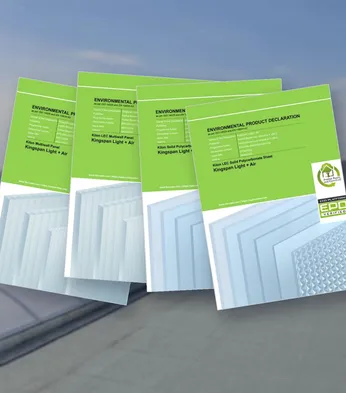
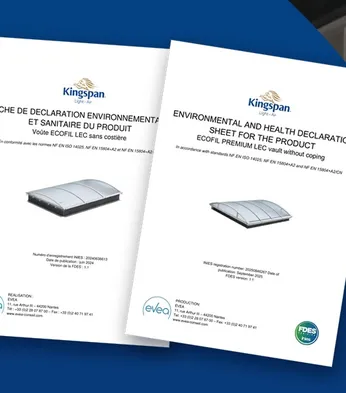
EPDs are often published on manufacturers’ website, in product literature, or in widely accessible EPD registries managed by industry groups or certification bodies.
10. Why are EPDs so important to us at Kingspan Light, Air + Water?
As a whole Group, Kingspan is committed to Planet Passionate, our 10-year sustainability program aimed at positively impacting climate change, circularity and nature protection. Through Planet Passionate, we are determined to reduce our manufacturing carbon emissions (CO2e) to as close to zero as technically possible, ultimately helping us to deliver products with lower embodied carbon (LEC) to the construction industry.
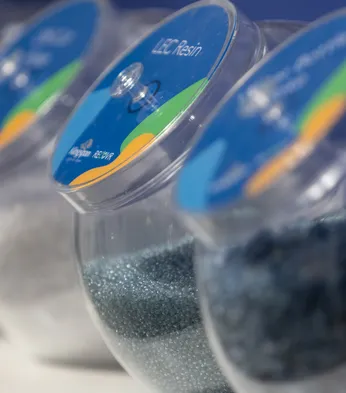
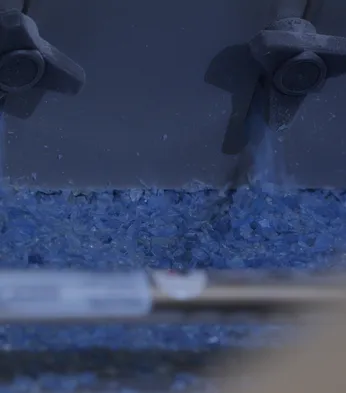
At Kingspan Light, Air + Water, we have been using EPDs to help identify areas where we can reduce our products' environmental footprint— such as selecting more sustainable raw materials, optimising supply chains, and improving waste management practices. incorporates 50% post-consumer recycled (PCR) polycarbonate from large blue water dispenser bottles and is manufactured at our state-of-the-art Daylight Centre of Excellence (DCOE), in Ireland. Polycarbonate is fully recyclable at end of life and can be remanufactured to create a range of new products with no loss of material quality.
Kingspan Light, Air + Water
Talk to Our Team
Our team is available to support you from first enquiry through to completion.